How does a brake work on a hand winch?
This blog will explain how the brake of a hand winch works. It will also be explained with a video at the bottom of the blog.
Does a hand winch have an automatic brake?
Yes! every hand winch from Gebuwin is equipped with an automatic brake! The brake is one of the most important components of the hand winch. Heavy loads are lifted and/or pulled with hand winches. The brake ensures that when the crank is released, the load remains stationary.
Before we explain the brake, first this…
Gebuwin uses different transmissions, namely a gear and a worm gear.
In a worm gear transmission, the worm gear is perpendicular to the worm shaft, which causes a lot of friction. The efficiency is therefore much lower than a gearbox, but there is also an advantage.


The advantage
The friction also provides a natural braking effect.
Suppose we take the brake off the winch and you let go of the crank. The load will then slowly drop due to the frictional effect of the worm gear winch. With a gear winch, the load will fall down immediately at high speed. A worm gear winch is therefore inherently safer.
But how does the brake work?
When lifting a load, turn the crank clockwise so that the worm shaft turns clockwise as well. Behind the worm shaft is a ratchet wheel mechanism and a brake disc. When the worm shaft turns clockwise, the ratchet wheel also turns clockwise. This causes the pawl to fall over the hooks of the pawl-wheel, which makes a rattling noise during hoisting. The brake disc behind the pawl wheel also turns clockwise. So there is no friction during hoisting as everything is rotating in the same direction.
The crank is released and now?
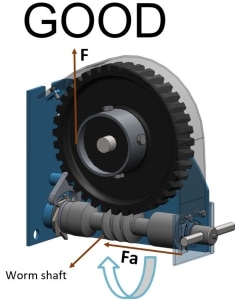
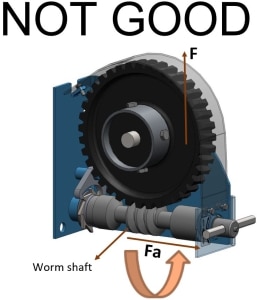
The load (F) is connected to the drum by a cable and gravity causes the cable to pull on the drum and thus the worm wheel. The worm gear therefore wants to rotate clockwise and the worm shaft and thus the ratchet wheel want to rotate anti-clockwise. This causes the worm shaft to be pushed backwards (Fa), creating pressure against the ratchet wheel and brake disc. This causes the worm shaft to be pushed backwards (Fa), creating pressure against the ratchet wheel and the brake disc. The pawl wheel stays in position, causing friction between the pawl wheel and the brake disc. The composition of the brake disc ensures that the load comes to a standstill. To lower the load, turn the crank anti-clockwise, you actually push through the brake.

One more important point
It is very important that the cable is wound onto the drum correctly. The load must ensure that the worm shaft is pushed against the brake disc. If the cable is wound on the drum in the wrong way, the forces will also be pushed in the wrong direction.

Need help with your project?
Gebuwin is happy to advise you about the options, the products and the accessories. Of course you can also contact us directly for product requests, we will be happy to help you.
CONTACT USCALL FOR ADVICE +31 (0)543 532 600
MAIL TO INFO@GEBUWIN.COM


